
Kwanza Jones Is Set to Become MLB's First Black Woman Majority Owner.
Kwanza Jones is making history, and if you don't know her name yet, you need to.
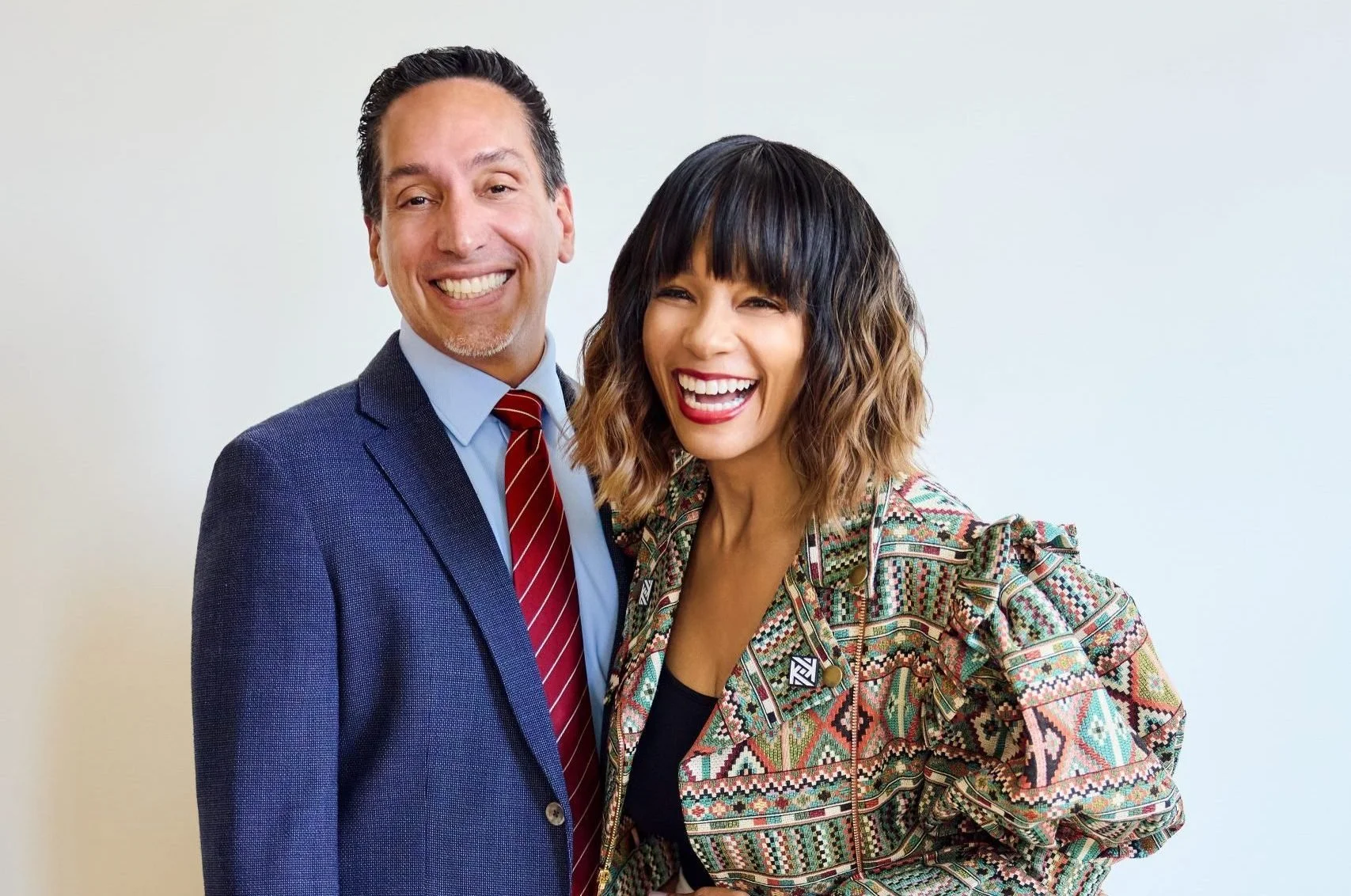
Kwanza Jones and her husband, José E. Feliciano.
Major League Baseball has existed since 1903. In that time, the sport survived two World Wars, integrated its rosters in 1947 when Jackie Robinson stepped onto a Brooklyn field and changed American history, and has been worth billions of dollars for decades. In all of that time, not one Black woman has ever held majority ownership of one of its 30 franchises.
Until now.
Kwanza Jones is set to become the first Black woman majority owner in MLB history, leading an investor group acquiring the San Diego Padres at a record $3.9 billion valuation, pending league approval expected around this summer's All-Star break. Her husband José E. Feliciano, born in Puerto Rico and co-founder of Clearlake Capital with more than $90 billion in assets under management, would simultaneously become the league's second Latino majority owner.
Sit with that.
She Is Not New to This
Before the Padres, before the nine-figure philanthropy, before any of the headlines running this week: Kwanza Jones was a college student who walked into the Apollo Theater on Amateur Night and won.
While studying Public and International Affairs at Princeton University, Jones performed at the Apollo's Amateur Night and won, launching a music career that would eventually produce nine Billboard-charting singles. The Apollo does not give participation trophies. That stage has humbled legends. She walked up and earned it.
She went on to earn a law degree from Cardozo School of Law, a Master of Dispute Resolution from Pepperdine, taught cross-cultural negotiation as an adjunct professor at NYU, and served as a court-appointed mediator in New York City Civil Court. She is not a figure who wandered into power through proximity or inheritance. She built the credentials, then built the platforms, then used both to build something much larger than herself.
Jones founded SUPERCHARGED as a motivational media company rooted in her belief that culture, community, and capital are not separate lanes. They are the same road. Through the Jones-Feliciano Initiative, she and her husband have committed nearly $500 million to advancing education, entrepreneurship, equity, and empowerment. That is not a press release number. That is a body of work.
She donated $1 million to Bennett College, one of the country's oldest HBCUs for women, to sustain women of color in higher education. Her mother, aunt, and extended family are all Bennett alumnae, making the gift personal as much as philanthropic. In 2020, she committed $20 million to Princeton University, the largest gift ever from Black and Latino donors in the school's history, to expand the student body and strengthen access and inclusion. Three years later, Princeton unveiled two residence halls bearing the names of Jones and Feliciano: the first buildings in the university's history ever named after Black and Latino donors.
She was also Miss Baltimore after graduating from Princeton. She was a singer on an independent label. She was figuring it out, making it work, and refusing to accept the version of the world that told her no. That is the part that does not make it into the biography. That is the part that makes this story ours.
The Apollo Is in Her DNA. And She's Taking It to the Streets.
Jones did not just win on that Harlem stage and move on. She eventually joined the board of the Apollo Theater and then invested in its future in a way the institution has never experienced in its nearly 100-year history.
In December 2025, Jones and the Apollo announced Culture In Motion, a national roadshow to bring Apollo programming, live performance, and SUPERCHARGED empowerment experiences directly into neighborhoods across the country. At the center of it is the SUPERCHARGED Boost Bus, a custom mobile cultural hub designed to transport the Apollo's legacy of artistry, storytelling, and Amateur Night spirit directly to local communities, meeting people where they are. The Apollo has never done anything like this in 91 years.
The roadshow has already reached the Mid-Atlantic, activating communities across Virginia Beach, Hampton, Norfolk, Richmond, Baltimore, and Washington, D.C., specifically engaging HBCUs including Hampton University, Norfolk State University, and Howard University, along with KIPP DC schools. Howard University, known as The Mecca, produced Kamala Harris, Thurgood Marshall, Toni Morrison, and Chadwick Boseman. It is now part of the network Kwanza Jones is building for the next generation.
"My Apollo story started on the Amateur Night Stage. That moment changed my life. Now, we're bringing that kind of transformation to communities everywhere. Everyone deserves a stage, a story, and a boost." — Kwanza Jones
What "First" Costs Us
There is something uncomfortable about celebrating a first in 2026. It means acknowledging the years of exclusion that made it possible for the word "first" to still apply.
Black women have been building, investing, leading, and creating wealth in this country under every conceivable obstacle. They have owned businesses through redlining. They have built institutions that sustained entire communities. They have written the cultural playbook that American entertainment has profited from for over a century. And yet the ownership suites of professional sports leagues, the spaces where the real financial power lives, have remained locked.
Across all four major professional sports leagues, not one franchise is majority-owned by a Black person. The NFL has never had a Black principal owner. The NBA's only Black majority owner, Michael Jordan, sold his stake in the Charlotte Hornets in 2023. MLB had none until this announcement.
There are minority stakeholders in each league. There are celebrity partnership deals and limited equity shares. But majority ownership, where the real decisions and the real returns live, has remained almost exclusively white.
These are not oversights. They are outcomes.
Jones stepping into that ownership seat is not about sports fandom. It is about who gets to hold power in industries that shape culture, generate wealth, and set the terms for what is possible. It is proof that access, when fought for and funded, eventually breaks through.
She Could Be Anyone of Us
For every woman reading this who is building something, funding something, fighting for a seat at a table that was never designed to include her: Kwanza Jones is the evidence that the table itself can be bought, renamed, and rebuilt with different people around it.
She started on an Amateur Night stage in Harlem because she had a voice and she used it. She built a law career because she understood that access requires fluency in the language of power. She gave back to HBCUs because she understood that the next Kwanza Jones needs the same doors she walked through. And now she is buying a Major League Baseball franchise. Because the capital exists, the vision exists, and there is no legitimate reason it should not be her.
In their joint statement, Jones and Feliciano said: "The Padres are more than a baseball team; they are a unifying force in San Diego, rooted in community, connection and belonging." Coming from two people who have spent decades building exactly those things, that is not a talking point. That is a thesis they have already been living.
The formal vote among MLB club owners is expected in June. The transition follows after that. But the declaration has already been made.
Major League Baseball has existed since 1903. In all that time, no Black woman held a majority ownership stake in one of its franchises. Kwanza Jones is changing that. And she has been preparing for exactly this her entire life.
